Blog
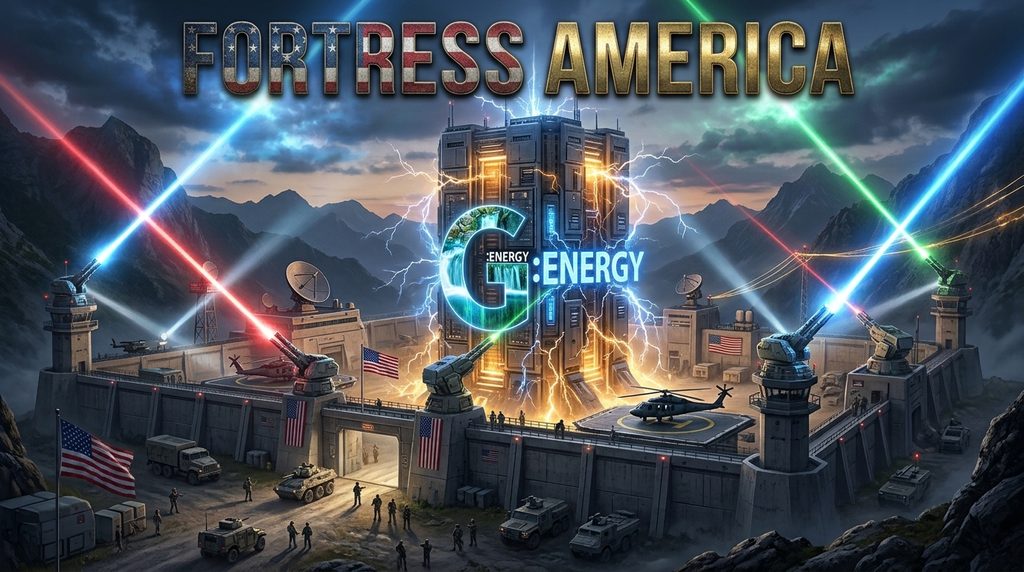
The Solution to FORTRESS America
G:energy | Energy-secure bases
The Solution to FORTRESS America
The Secretary of War wants every major U.S. military installation to make its own power and keep running if the grid goes down. G:energy’s answer is a generator, water supply and food system built inside the base fence and paid for with private capital. Below is what has been said, and an honest, requirement-by-requirement look at what we meet today and what a 1 MW demonstration still has to prove.
What the Secretary has said
Defense Secretary Pete Hegseth unveiled FORTRESS America in his September 30, 2026 “State of the Force” speech. A follow-up memo ordered a program office stood up within 30 days. These are the statements the requirements below come from.
“America cannot be starved out, shut down, or cut off.”Sec. Pete Hegseth, as quoted by The War Zone
“Power is combat now.”Pentagon spokesperson Sean Parnell, as quoted by The War Zone
Every major military installation would generate its own power, “independent of the civilian grid.”Hegseth, as reported by Air & Space Forces Magazine, Oct. 20, 2026
- Energy independence
- Supply chain and defense industrial base resilience
- Strategic defense reserve
- Installation hardening and cyber resilience
- Resilience in space and spectrum
About the “90 days.” Several outlets report a requirement that every major continental U.S. installation sustain essential operations on its own for at least 90 days, including power, water, fuel and communications. That figure traces to a Fox News Digital report citing internal planning documents. The Pentagon has not published it, and the reporting we reviewed does not show it in the memo text. We treat it as the likely benchmark, not a confirmed rule. Officials are still assessing roughly 500 bases, no cost or schedule is public, and one official said full implementation could take decades.
How we get from claim to proof
The proposal is built in three phases. Phase 1 is the test that closes most of the gaps above.
1 MW
Phase 1: Prove it
- Four towers, about 52,000 sq ft in total
- About $9.8M construction
- Goal: continuous 24/7 generation, audited results
- Includes data center space and atmospheric water generation
12 MW
Phase 2: Integrate it
- Adds an 11 MW module
- About $76.8M construction
- Indoor farming, aquaculture, water and a 120-rack data center
- Phases 1 and 2 combined budget about $86.6M
321 MW
Phase 3: Scale it
- A self-contained base on 50 to 300 acres
- Privately financed, not a grant
- Paid for by selling electricity, water, food and data services
One plant, three kinds of independence
FORTRESS America asks for energy first. G:energy’s design adds the other two things a base needs to hold out.
Electricity
On-base generation inside the security perimeter, with a tariff that falls 1% a year.
Water
Atmospheric water generation, treatment and recycling on site, plus desalination where a base has ocean access.
Food
Indoor farming and aquaculture on base, which means fewer convoys and shorter supply lines.
Base energy offices and program teams
If you are assessing installations under FORTRESS America, we would like to show you the Phase 1 plan and the test data we intend to produce.
Sources and notes
- Air & Space Forces Magazine, Oct. 20, 2026: Hegseth’s Sept. 30 speech, five pillars, roughly 500 bases, cost and timeline.
- The War Zone: quotes, memo timeline and the 90-day reporting.
- Newsweek and Fortune: the Fox News Digital report behind the 90-day figure.
- G:energy project data comes from the Unsolicited Proposal for Phase 1 (October 2025), the Phase 1 grant summary (December 2025) and the Why and How Base Security deck.
Disclaimer. G:energy is a private company. It is not affiliated with, endorsed by or selected by the Department of War or the Department of Defense, and “FORTRESS America” is a government program name used here only to describe the requirements. Capacity, cost and schedule figures are proposal targets, not measured results.
admin
0